

Simplifying IoT Development: The Cost Benefits of Flutter Explained
Find out how Flutter streamlines development and maintenance for connected devices—insights straight from Grzegorz and Matteo, the experts driving our Flutter shift at Intent.


Developing and maintaining a health tracker app across multiple platforms quickly becomes a costly challenge when tangled legacy code and fragmented updates pile up. Every new feature requires excessive resources, consistency suffers, and your development teams spend more time navigating complexity than innovating.
Flutter offers a fresh way forward. It's a modern framework designed to simplify app development by using one unified codebase across all platforms. This streamlined approach significantly reduces both upfront costs and long-term maintenance, enabling your teams to deliver seamless user experiences without draining your budget.
At intent, we’ve encountered this exact scenario with our clients in the connected device industry. IoT projects frequently become mired in software complexity that stretches beyond hardware and firmware. Platform-specific code can rapidly inflate costs and complicate maintenance. Recognizing this, we turned to Flutter—Google’s open-source UI toolkit—to consolidate our development efforts, saving substantial resources along the way.
We spoke with Grzegorz Miszewski, our senior mobile engineer, who spearheaded our adoption of Flutter in IoT projects. He shared how Flutter has transformed not just app development, but also significantly improved our workflow around complex protocols like Bluetooth LE. With a single, streamlined codebase, we’ve been able to shorten build cycles and dramatically lower ongoing maintenance expenses.
In this article, we’ll show exactly how Flutter tackles the financial challenges inherent to IoT development. You'll see real-world examples from our work, practical insights into Flutter’s cost-saving capabilities, and why it might be the right tool to keep your next project within budget.
Whether you're a software engineer navigating cross-platform headaches, a Bluetooth specialist grappling with connectivity hurdles, or a decision-maker focused on cost-effective development strategies, you’ll find valuable insights here based on practical experience.
Let’s explore how Flutter is reshaping IoT application development—simplifying maintenance, reducing costs, and clearing the path for innovation.
Unified Codebase: Reducing Development Costs
When building IoT applications, maintaining separate codebases for each platform quickly inflates costs. Different platforms require their own dedicated teams, testing processes, and maintenance schedules, easily doubling—or even tripling—your overall expenses.
Grzegorz emphasized:
“Having one single codebase means you write the code once, and it runs seamlessly on both Android and iOS. This is crucial in IoT projects where consistency and cost-efficiency are paramount.”
With Flutter, developers can:
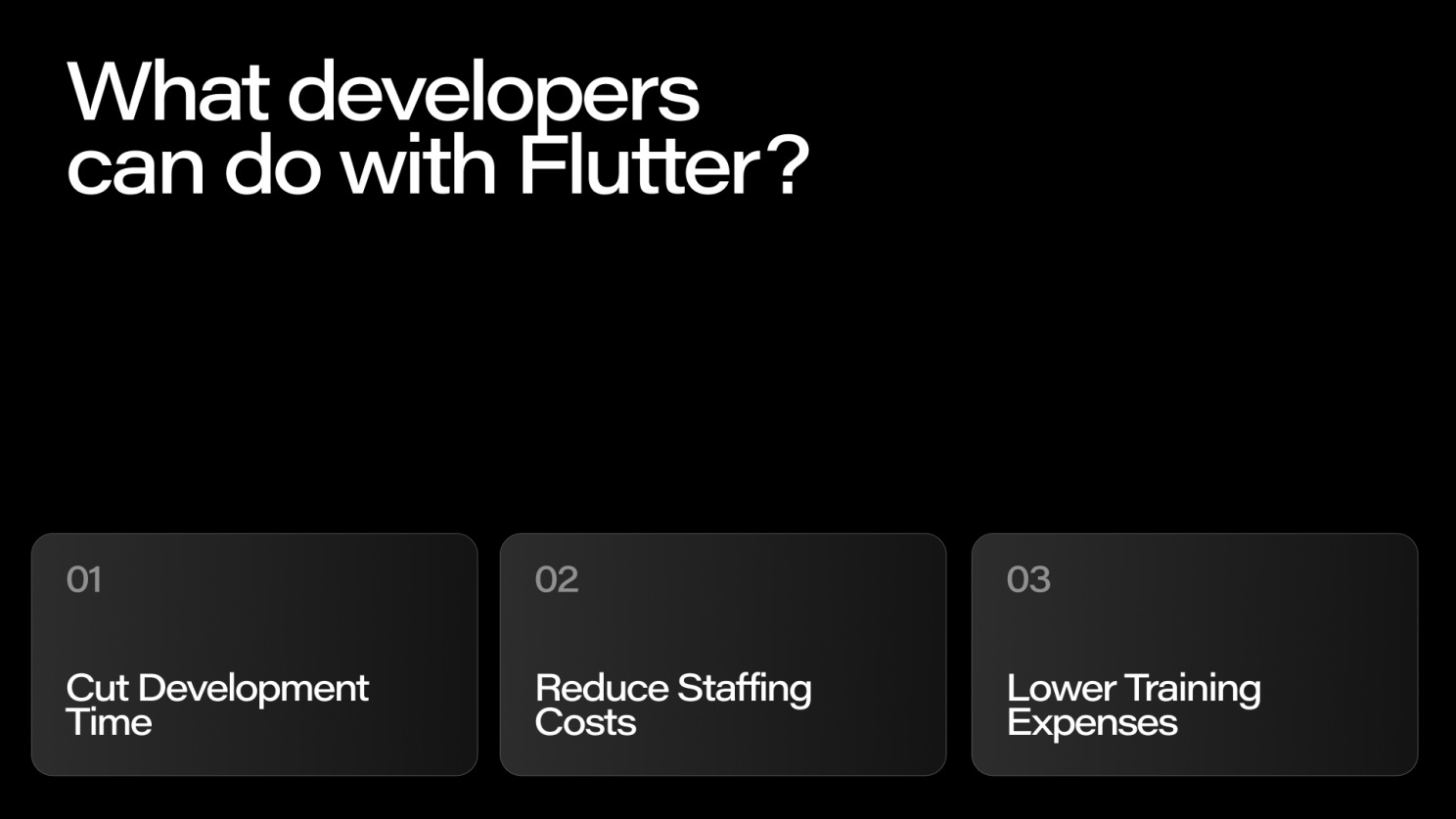
Cut Development Time: A single codebase reduces the total development time compared to writing separate native apps for each platform.
Reduce Staffing Costs: Fewer developers are needed since one team can work across all platforms.
Lower Training Expenses: Team members only need to learn one language (Dart) and one framework, reducing the time and cost associated with training. This also positively impacts the internal recruitment process.
In one of our recent projects, we developed an IoT application for a wearable device. Initially, native development projected a 12-month timeline and required separate Android and iOS teams. By switching to Flutter, we shortened the timeline to just 7 months and reduced the team size by 30%, achieving substantial cost savings.
Accelerated Development with Knowledge Sharing
Beyond the unified codebase, Flutter enhances overall team productivity, directly translating into lower costs. Grzegorz highlighted this clearly:
"It’s not just two times faster because you’re developing for two platforms; it’s potentially ten times faster due to shared knowledge and streamlined processes."
With quicker development cycles, your product gets to market faster, cutting down opportunity costs. Your team spends less energy coordinating across platforms and more time actively building the product. Plus, when updates or bug fixes are required, you only have to address them once, significantly reducing the long-term expenses associated with juggling multiple codebases.
Simpler collaboration, rapid iterations, and easy maintenance—all these add up to substantial cost savings over the lifetime of your IoT project.
Hot Reload: Minimizing Development Downtime
Every minute a developer waits for code to compile or an app to restart is a minute of lost productivity—and money.
Flutter’s Hot Reload feature addresses this: “With Hot Reload, you don’t need to recompile or reconnect to your device every time you make a change. It saves significant time and keeps the development flow uninterrupted.”
Why does this save money in IoT development:
Increased developer productivity: Developers can implement and test changes faster, reducing billable hours.
Lower testing costs: Immediate feedback reduces the time spent on testing cycles.
Faster debugging: Quick identification and resolution of issues prevent costly delays.
Robust Support for IoT Protocols: Saving on Integration Costs
Integrating IoT protocols can be complex and expensive, especially if you need to develop custom solutions. Flutter simplifies this:
Bluetooth LE (BLE)
Ready-Made Libraries: Libraries like Flutter Blue and Flutter Reactive BLE reduce the time and cost associated with developing custom Bluetooth solutions.
Community Support: A strong community means faster problem resolution without expensive consultations.
“The big players in IoT are already leveraging Flutter’s capabilities. The libraries are mature, and the community support is strong,” noted Grzegorz.
Wi-Fi, HTTP, MQTT
Seamless Integration: Built-in support for essential IoT protocols means less time (and money) spent on developing custom integrations.
Reduced Licensing Costs: Open-source libraries eliminate the need for expensive third-party licenses.
Cloud Integration: Cutting Backend Costs
Cloud services might be necessary, but they often come with a hefty price tag. Flutter helps keep these costs down by enabling streamlined integration options, such as free, scalable solutions like Firebase. Firebase covers essentials such as authentication and databases without inflating your backend budget. Additionally, Flutter’s straightforward integration with third-party cloud providers lets you shop around for solutions that best match your project's budget and needs.
Grzegorz highlighted this benefit:
“With Flutter’s integration capabilities, connecting your IoT app to cloud services is straightforward, allowing for features like real-time updates and remote device management without hefty development costs.”
Security: Preventing Expensive Breaches
Security breaches can be considered as costly headaches. Flutter significantly lowers your risk here through built-in secure communication protocols, helping you avoid the high cost of developing custom security measures. The framework’s proven reliability also inspires confidence: major financial services like Google Pay rely on Flutter, demonstrating its ability to handle sensitive data safely.
Grzegorz summed this up:
“If Google trusts Flutter for handling payments with Google Pay, it’s a strong testament to its security capabilities. That means less money spent on security audits and fixes.”
Testing Tools: Reducing Quality Assurance Costs
Testing might be critical, but it's often expensive and time-consuming. Flutter’s comprehensive testing toolkit helps trim those costs by providing automated testing solutions, covering everything from unit and widget tests to full integration testing. With quicker iterations and reliable automated testing built into your workflow, you can reduce the time and money spent on manual QA cycles and still deliver a top-quality product.
Access to Device Sensors: No Need for Custom Development
Tapping into device sensors traditionally means extra development effort—and additional costs. Flutter helps sidestep these expenses with its extensive set of pre-built sensor libraries. This ready-made approach allows you to quickly access a wide variety of sensors, keeping development costs under control.
Even better, Flutter's active community regularly updates these libraries, ensuring ongoing compatibility as new devices hit the market. And if you need something highly specific? You still have flexibility: leveraging native code remains possible through native bridges or by using tools like dart:ffi and dart:jni, all without breaking your budget.
Thriving Community and Ecosystem: Free Resources and Support
One of Flutter’s biggest perks doesn't cost a cent: its thriving community. With an open-source ecosystem that continues to expand, you'll often find community-developed libraries and tools available at no extra charge.
Moreover, peer-driven forums and active community channels mean you can tackle problems quickly without relying on costly consultants.
As Grzegorz mentioned:
“The Flutter community is big and growing. There are libraries for almost everything you need, and the support is fantastic”.
Flutter vs. React Native and Native Development: A Cost Comparison
When considering the financial aspects, Flutter stands out in:
Lower development costs: Compared to native development, Flutter can reduce costs by 50% or more due to the single codebase.
Less maintenance overhead: Fewer platforms to support mean ongoing maintenance is cheaper.
Better performance than React Native: Flutter’s performance can lead to lower hardware requirements, saving costs on device compatibility.
Grzegorz concluded:
“For IoT development, Flutter is my go-to choice. It simplifies the process and significantly reduces both development and maintenance costs compared to other platforms.”
Conclusion
Ultimately, we reach an understanding that Flutter provides a practical and efficient approach for IoT development that truly helps maintain cost control without sacrificing quality.
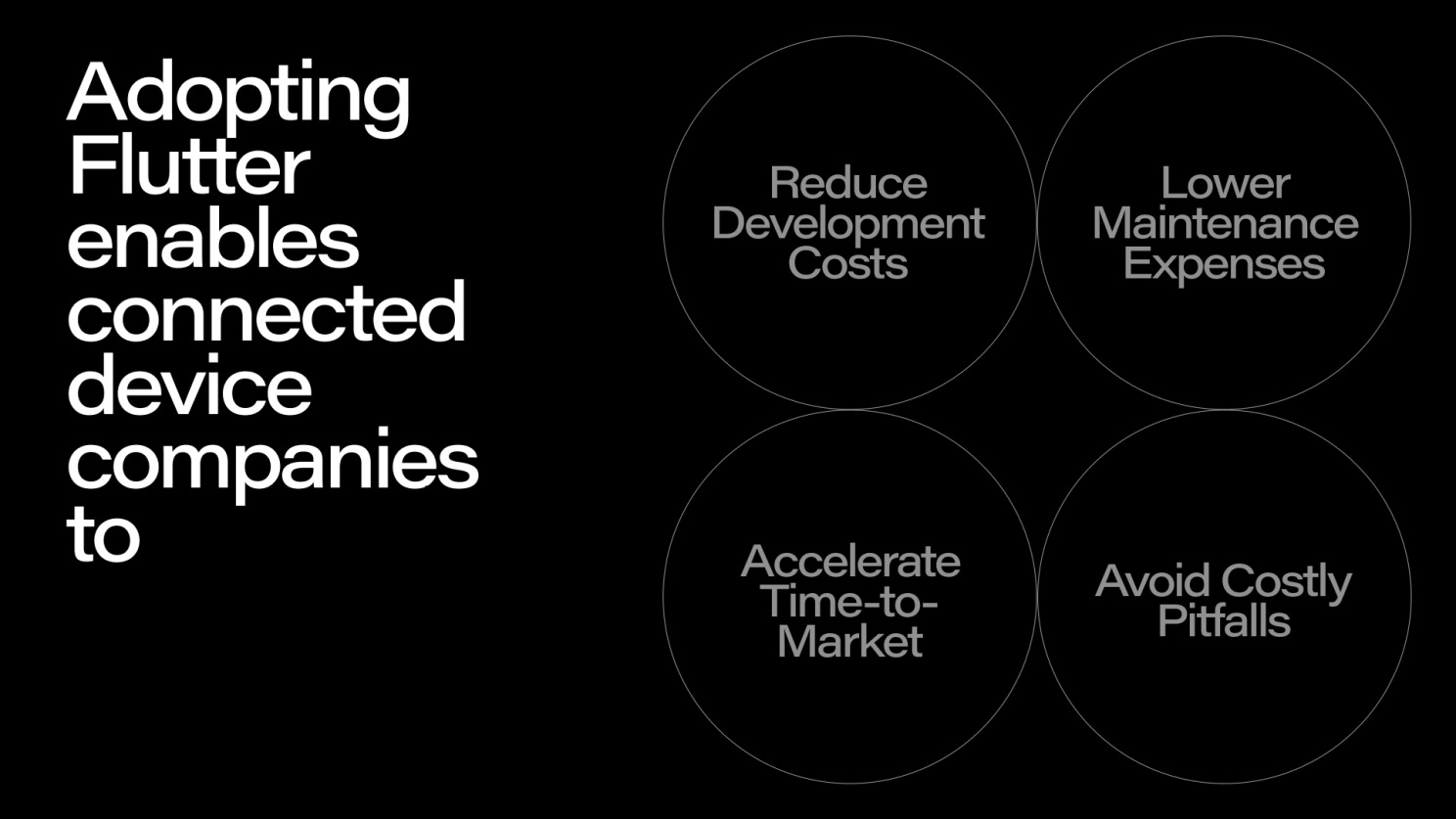
By adopting Flutter for your connected device projects, your team can:
Reduce development costs thanks to a single, unified codebase and quicker release cycles.
Lower ongoing maintenance expenses by simplifying updates and streamlining fixes across all platforms.
Speed up your time-to-market, helping your product generate revenue sooner.
Minimize risks using Flutter’s built-in security and extensive testing capabilities, helping avoid expensive pitfalls.
At intent, we regularly use Flutter to help clients build cost-effective, high-quality IoT solutions. If you’d like to discuss how Flutter could fit into your own IoT projects, we’d be happy to chat.
What’s been your experience with Flutter in IoT development? We'd love to hear your thoughts. Share them in the comments below!